Impulse
Conversion-led

Fast-moving DTC brands selling mostly on mobile from paid social.
Launch and learn. Start on a proven theme, then customise the product pages, landing pages and tracking your ads rely on.
Shopify store development, from the first design to launch. We build the store and move your catalogue from another platform. Then we connect it to the systems that run your orders, stock and finance.
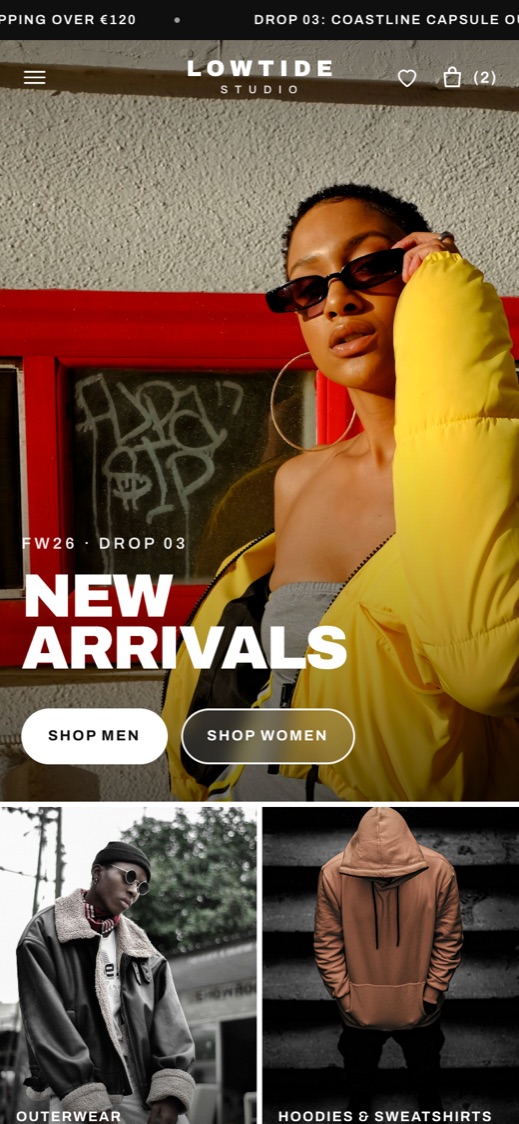





Shopify store development starts with how you sell. Often a proven theme is enough. We add custom work only where your products or buyers need it.
Fast-moving DTC brands selling mostly on mobile from paid social.
Launch and learn. Start on a proven theme, then customise the product pages, landing pages and tracking your ads rely on.
Fashion, interiors and premium brands where the store is part of the product.
Make the store part of the brand. We design around your art direction and product stories, with sections your team can reuse.
Brands selling personalised or made-to-order products: gifts, packaging and print.
Show buyers what they will get. Add product options, a configurator or a 3D preview when it helps them choose.
Manufacturers and distributors moving trade orders off email and spreadsheets.
Take trade orders online. Company accounts, customer prices and quick reorders, with each order passed to your ERP.
Example stores, built as demos. Client work is in the case studies below.
Shopify store development for PuzzlesPrint, and two ecommerce platforms we built and improved.
PuzzlesPrint · custom photo puzzles
We moved PuzzlesPrint from a slow, plugin-heavy WordPress store to Shopify. Customising a puzzle now takes one click instead of seven.

Auto Kada · auto parts wholesale
A trade store for mechanics and workshops, with prices per customer and live stock in every warehouse.

Andele Mandele · second-hand marketplace
One of Latvia's largest second-hand marketplaces. We refined the interface, modernised payments and made the busiest pages more reliable.

Shopify store development covers the storefront and the systems behind it.
A theme built from reusable sections, so your team can update pages without a developer.
Move products, customers and URLs with a full redirect map, then check everything at launch. How we plan a migration
Company accounts, trade price lists and order rules, matched to the right Shopify plan. How B2B works on Shopify
Custom features for the rules that Shopify settings and existing apps can't handle.
Upgrade to Plus only when checkout or B2B needs justify the cost. Checkout changes go through Shopify's checkout extensions.
Lookbooks, guides and landing pages come from a CMS, so editors publish without touching the theme.
Attributes, media and translations come from your PIM, so each product reaches Shopify complete.
Orders, stock and prices move between Shopify and your ERP. Each field has one owner, and a failed sync raises an alert.
Customers, orders and consent go to your CRM, so your team sees each buyer's full history.
Invoices, VAT and payouts post to your accounting software and are matched to Shopify orders.
Shopify store development includes the systems behind the store. We connect them, so orders, stock and invoices move without anyone retyping them.
 Your Shopify store→sends←gets back
Usually, yes. We check its API first, then tell you what can move and how often.
The order waits in a queue and we get an alert. Once the problem is fixed, it goes through, so no order is lost.
An app when it covers your rules. Custom code when it doesn't, for example B2B prices or several warehouses.
With a free integration audit. We map your systems and what should move, then send a priced scope.
Shopify store development is the start. Once the store is live, we help you bring in buyers with search, email and ads.
Get found on Google, and get named when people ask ChatGPT or Gemini what to buy.

 ChatGPT

Abandoned-cart, welcome and repeat-order emails that run on their own once they are set up.


Google and Meta campaigns, judged on the revenue and margin they bring to your store.
 Google Ads

Short answers about Shopify store development. Ask Cody for anything else.
Shopify store development covers the theme, custom features, app setup and the systems behind the store. Depending on the project, it also includes a migration from another platform, B2B ordering or ERP and accounting integrations. We scope it around how you sell, then price each phase.
The right Shopify store depends on how your customers buy. Fast-moving DTC brands do well on a proven theme with custom product pages, brand-led stores need their own design system, and trade buyers need company accounts and quick reorders. We start from your buyers, then decide how much custom work the store needs.
Yes, Shopify supports B2B ordering with company accounts, customer price lists, payment terms and quick reorders, and Shopify Plus raises the limits, for example on price lists. We map your accounts, prices and approval rules before we recommend a plan, and pass every trade order to your ERP.
Yes, we migrate stores to Shopify from WooCommerce, Magento and custom platforms, moving products, customers, orders and URLs. PuzzlesPrint moved from a plugin-heavy WordPress store, and customising a puzzle now takes one click instead of seven. Every old URL gets a redirect before launch.
A Shopify migration plan needs a data map, a redirect for every old URL and a test plan for checkout, payments and customer accounts. It also lists the apps and integrations to rebuild, and who checks indexing in Google Search Console after launch.
A move to Shopify keeps most of your search traffic when every old URL redirects to its new page and the titles and content stay the same. Nobody can promise unchanged rankings, so we compare traffic and indexing for several weeks after launch and fix what drops.
A Shopify store needs custom development when the theme and existing apps can't handle your rules, such as B2B price logic, product configurators or ERP connections. Custom code needs upkeep, so we add it only where an app won't do the job.
Most stores launch fine without Shopify Plus. Plus makes sense when you need checkout changes, very high order volumes or B2B rules with many price lists. We check your rules against each Shopify plan before you pay for an upgrade.
Yes, one Shopify store can sell in several countries through Shopify Markets, with local currencies, languages and domains. We set up the translations, hreflang tags and prices for each market, so every country gets its own version in search results.
Yes, Shopify can send orders to an ERP such as Visma Horizon, Jumis or Visma.net and get stock, prices and order status back. Each field has one owner, and a failed sync waits in a queue with an alert, so no order is lost. We check your system's API before we quote.
The free integration audit maps your Shopify store, the systems behind it and the data that should move between them, and how often. You get a list of the connections to build, with a ready-made app or custom code for each, and a priced scope.
Yes, after launch we run ecommerce SEO, AI search, email flows and Google and Meta ads for Shopify stores. Each channel is judged on the orders and margin it brings, and reported monthly. The details are on our ecommerce marketing services page.
Shopify store development is priced per project, after a short review of your store. The price depends on the storefront design, the catalogue and the integrations, so a launch on a proven theme costs far less than a migration with B2B pricing. You get a fixed price for each phase before work starts.
The time to build a Shopify store depends on three things: the design, how ready your product data is and the integrations. A store on a proven theme launches much sooner than a custom store with ERP links. We set dated milestones once the scope is clear.
Tell us what you sell, what your store runs on now and what needs to work better. We'll suggest how to build it.

A store is the start. Connect it to your systems, then let automation handle the busywork.
What we learn building AI systems, reports, secure software and stores, written down.
All insightsCody


 Puffer · M
 Hoodie · L
 Knit · M
 4

 Roll neck€89